
You walk down the basement stairs, flip the switch, and the room just sits there. Flat, dim, a little sad. The furniture is fine. The floor is fine. It’s the walls.
Most basement paint color ideas you find online are photo galleries shot under professional lighting, which is why those shades turn muddy once they’re eight feet underground. A color that looked warm on a chip at the store can read like wet cement in your basement space. One commenter on a homeowner forum checks a single number before recommending anything, and it settles most of the argument.
Getting to that number starts with what a basement does to color.
What Makes a Paint Color Work in a Basement?
Every paint color has a light reflectance value, or LRV, on a scale from 0 to 100. Sherwin-Williams puts it plainly on its own basement page: the higher the LRV, the more light a paint color will reflect.
Upstairs it barely matters; sunlight covers your mistakes. Downstairs, it’s the whole ballgame.
The lack of natural light also strips warmth out of a color. Cool grays and icy blues that look crisp upstairs go flat below grade; warm undertones hold up better under lamps and LEDs.
Sherwin-Williams warns against overcorrecting, too: avoid going too dark, especially if you don’t have a lot of natural or artificial lighting. And if a color reads too cold on your wall, the company suggests fixing the bulbs first: switch to warmer lighting to neutralize the blue undertones.
One more trap: the brightest, coolest white on the rack often looks dingy gray in a shadowed basement corner rather than crisp.
Which pushes most people toward one family of colors.
Warm Whites and Neutrals That Don’t Go Dingy
Warm white is the hard-to-regret lane: most light back, least risk.
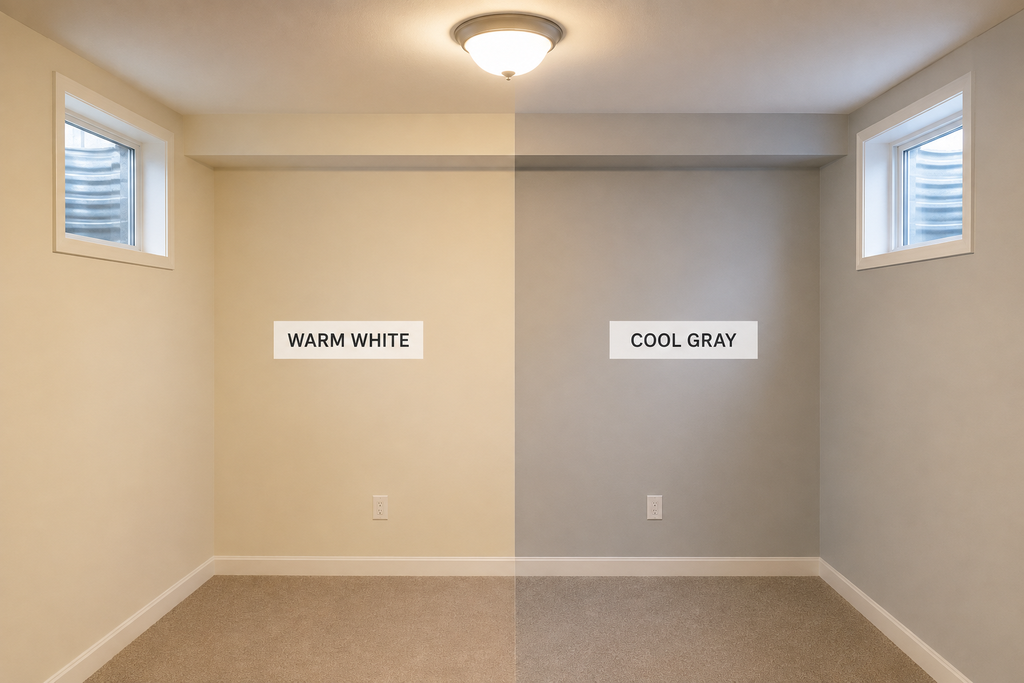
Sherwin-Williams Alabaster SW 7008 carries an LRV of 82.215, so it reflects about 82% of the light hitting it, with a creamy cast rather than a stark one. Benjamin Moore White Dove OC-17 sits right beside it at an LRV of 83.16, described by the company as a “clean and classic white.”
Sherwin-Williams’ own basement page points shoppers toward Snowbound SW 7004 and Shiitake SW 9173: one a soft white, one a warm neutral.
Greige, gray warmed with beige, reads as a real color instead of builder-grade blank while still throwing light around. In an open floor plan, one neutral paint throughout the whole level makes the space feel bigger than three would.
So is dark ever the right call down there?
Should You Ever Use a Dark Color in a Basement?
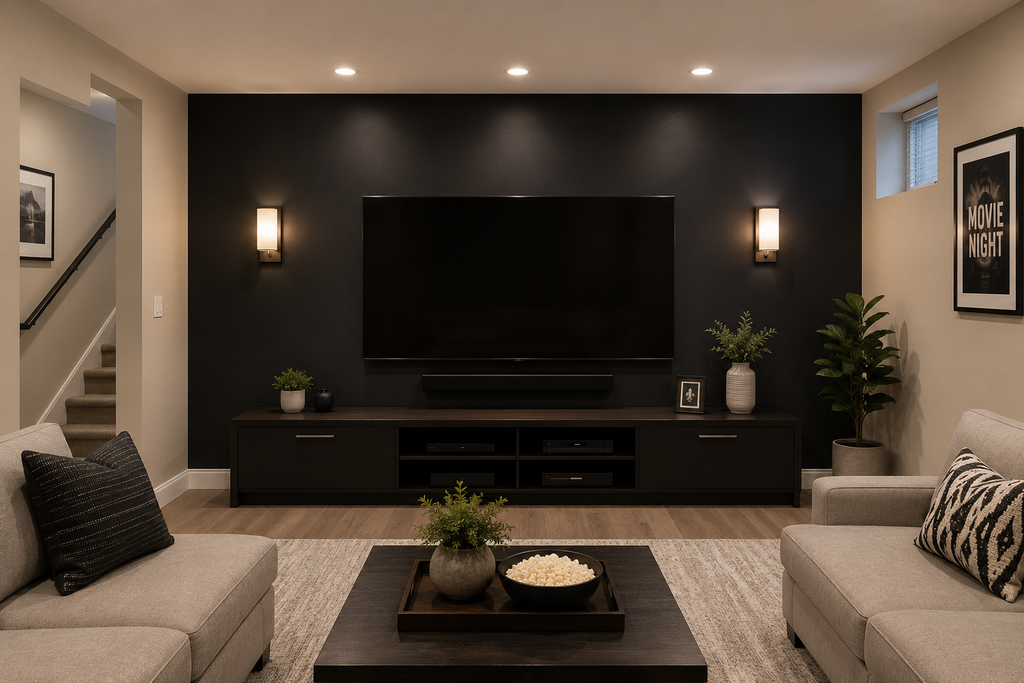
Yes, but only where the darkness is doing a job.
A home theater is the clearest case. Dark walls stop light from bouncing off the screen, and Sherwin-Williams notes that dark colors reduce light reflection and enhance contrast. Tricorn Black paint (SW 6258) takes that as far as it goes, with an LRV of 2.849. Under 3% of the light hitting that wall comes back.
A bar wall or the wall behind a mounted TV takes the same treatment without swallowing the room. That’s the accent wall color approach — one rich color in one place, warm neutrals everywhere else.
There’s also color drenching: walls, trim, and ceiling in one color. In a small basement, it helps because there are no hard edges for your eye to measure the room against, so it reads as a deliberate contemporary basement rather than a cramped one.
The rule our editorial team would hold to: add light before you subtract LRV.
Match the Color to How You’ll Use the Basement
How you use your basement should drive the color more than any trend list.
A basement office wants a calm mid-tone neutral. Greige keeps glare off your screen and looks decent on video calls, where a bright white wall blows out the camera. Save the pop of color for a bookcase back.
A basement family room does best with warm white walls and one rich color somewhere — a built-in, a fireplace surround, one accent wall. Basement living feels far less like a bunker when something isn’t beige. A home gym is the one place to go as bright as you can stand.
None of it works if the ceiling fights you.
What Color Should You Paint the Basement Ceiling?
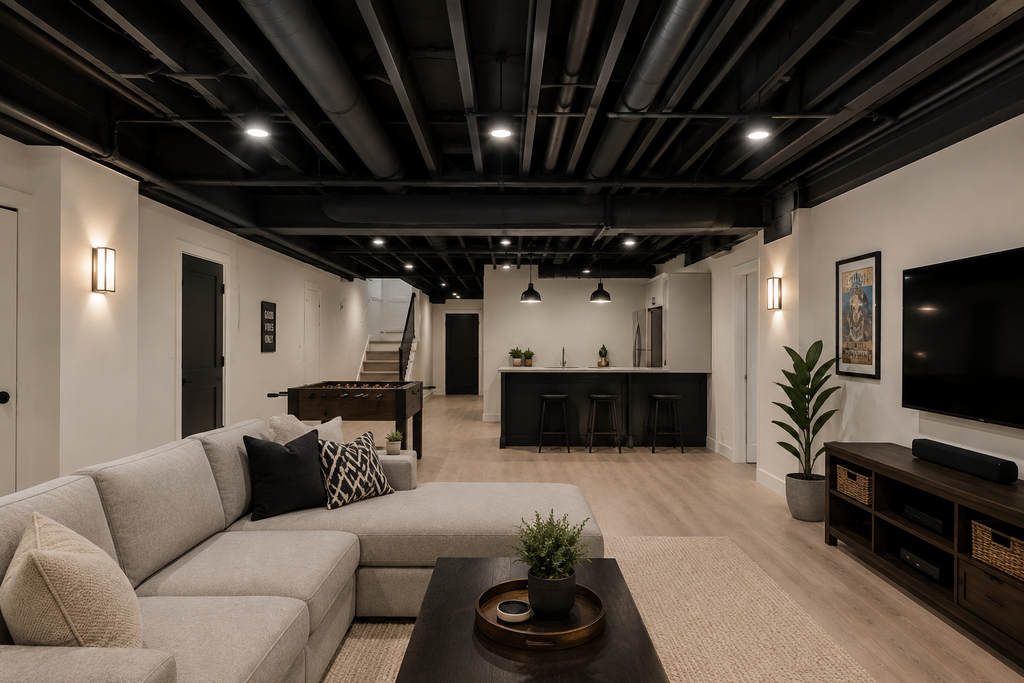
If your joists are exposed, painting the ceiling one flat dark color (black or deep charcoal) makes the ducts, pipes, and framing recede into shadow. It’s the best trick in low-headroom basement design.
With a finished drywall ceiling and low headroom, go the other way: the same white as your walls, or one shade lighter, in a flat sheen. Flat hides ripples that gloss would highlight.
Safety first here. Painting a ceiling means ladder work, and open joist bays usually hold electrical wiring, junction boxes, and, in some homes, gas lines. Never paint over or spray into an electrical box, and bring in a licensed electrician for anything that involves opening, moving, or covering one. Permit and inspection rules for work near wiring vary by state and municipality, so check with your local building department before you start.
The One Number to Check First
In a Houzz discussion about painting rooms with poor natural light, commenter Lyn Nielson gave a specific threshold: “For north-facing or low-light rooms, I choose a paint color LRV above 80.” They followed it with a recommendation for anyone who wants warmth rather than a stark white: “SW Alabaster is a great white for low light.”
That’s one person’s rule rather than an industry standard, but it points at something real: the manufacturers publish an LRV for every color they sell. So look up the LRV of every color on your shortlist before you fall in love with a swatch.
Just know that the perfect paint on a bad surface still fails.
On Bare Concrete, Prep Decides Everything
If your walls are bare block or poured concrete, prep matters more than the color.
Look for efflorescence, the white, powdery, crystal-like deposits that show up on masonry. Sherwin-Williams lists basement walls that are not properly sealed against ground moisture penetration among the causes, and says to remove it with a wire brush, power brush, or low-pressure washing and rinse thoroughly. Its blunt instruction: “Painting should be delayed if efflorescence continues.”
Then prime. A masonry bonding primer such as DRYLOK Wet Wall Bonding Primer is built for block, brick, and poured concrete, and the manufacturer is specific about limits: efflorescence must be removed first, and the product can be applied to a wet wall that is not actively leaking. Actively leaking is a repair job, not a paint job. Paint is a finish, not waterproofing, which is why the EPA’s moisture control guidance covers site drainage and foundations. The EPA also recommends keeping indoor relative humidity below 60 percent, ideally between 30 and 50 percent, so it’s worth buying a cheap hygrometer before you buy the paint.
Basements rarely have windows to open, so ventilation matters. The EPA notes that concentrations of many VOCs are consistently higher indoors (up to ten times higher) than outdoors and advises increasing ventilation and meeting or exceeding label precautions. Run a box fan during the job and for a few days after.
How to Test a Basement Paint Color Before You Commit
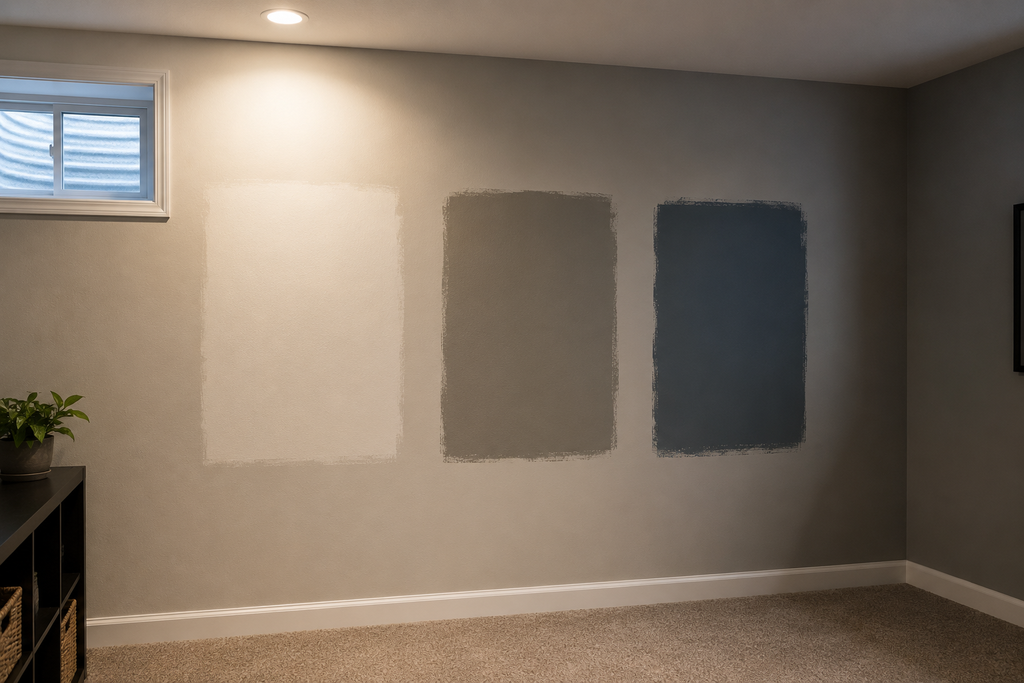
Never choose a chip under the store’s lights. Paint sample patches at least a foot square on two walls: one near your light source, one in the darkest corner.
Then look at 9 p.m. That’s when you’ll actually use the room, and it’s your bulbs doing the work, not the sun. If everything reads cold, change the bulbs before you change the color.
Live with the patches for three days. If it still looks good on day three, that’s your color.
The Bottom Line
In a basement, the light you have decides the color, not the other way around. Every color you’re drawn to has an LRV attached, and checking it takes ten seconds.
So do that today. Write down the colors you’re considering, look up the LRV of each, and count the light fixtures in the room. If the bulb count is low and the LRVs are low, you know whether you’re buying paint this weekend or lamps first.
FAQs
How many coats of paint do basement concrete walls need?
Bare masonry is porous and usually takes a dedicated masonry bonding primer plus at least two finish coats. Follow the coverage and recoat times printed on the primer and paint labels, since they vary by product.
Can you paint a basement in winter?
Yes, since a conditioned basement stays at a fairly steady temperature year-round. The bigger issue is ventilation, because you can’t open windows for fresh air. The EPA advises increasing ventilation and meeting or exceeding label precautions when using products that emit VOCs.
Does painting a basement help it sell?
Fresh, light neutral paint is one of the cheapest ways to make a below-grade room photograph and show better, but it doesn’t correct a moisture problem underneath. Buyers and inspectors look for water staining and efflorescence regardless of wall color.
What paint sheen is best for basement walls?
Flat and matte hide surface imperfections in older masonry and drywall, while eggshell and satin are easier to wipe down in high-traffic areas like stairwells and playrooms. Sheen choice is a durability-versus-appearance tradeoff rather than a rule.
Should the basement stairwell match the basement walls?
Carrying the same color from the stairwell into the main basement space makes the transition from upstairs feel intentional and the lower level feel larger. Breaking color at the stair landing tends to make a basement read as a separate, smaller add-on.
